
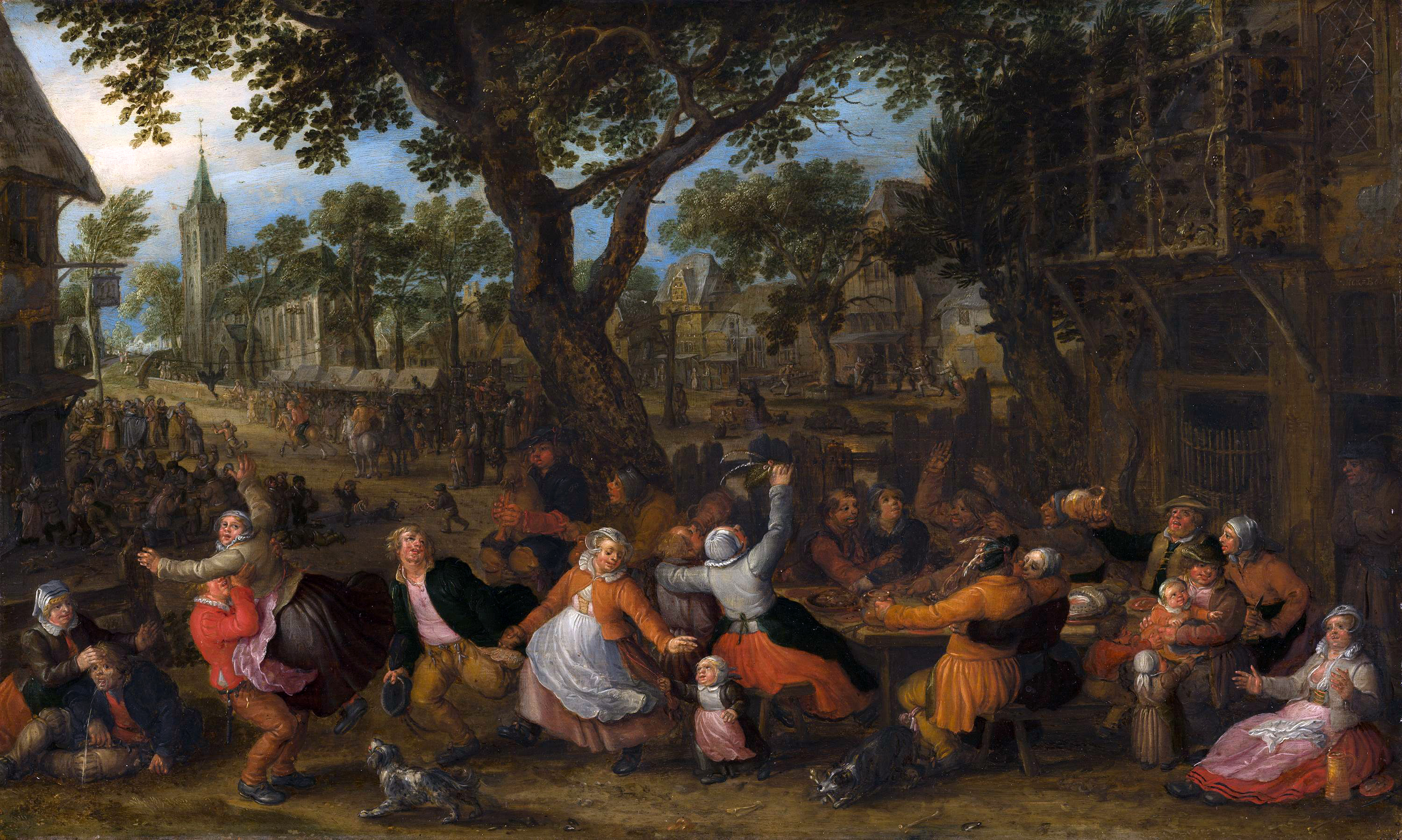
Image: Vinckboons, Foire de village
First violins, Olivier Brault, Anthony Marini and Kinga Ujszászi
Second violins, Karolina Radziej, Lucie Ringuette and Kaisa Ruotsalainen
Violas, Mari Giske and Tuula Riisalo
Cellos, Tatu Ahola, Gunnar Hauge and Susie Napper
Bass, Reuven Rothman
Flutes, Matthias Maute and Sophie Larivière
Hardanger violin, Ragnhild Hemsing
Harpsichord, Gunnhild Tønder
Organ, Anna-Maaria Oramo
Guitar, David Jacques
Lute, Jadran Duncumb
Percussion, Ziya Tabassian
Conductor
Matthias Maute
Gropen (Montréal Baroque Festival Choir)
Finnish psalm book (1701)
Psalm
Pierre Verdier (1627-1706)
Lamento
Dietrich Buxtehude (1637-1707)
Cantata Was mich auf dieser Welt betrübt BuxWV 105
Arcangelo Corelli (1653-1713)
Sinfonia from the oratorio Santa Beatrice d’Este
Nous goûtons une paix profonde (Montréal Baroque Festival Choir)
Traditional (Norway)
Paa Jorden Fred og Glæde
Marc-Antoine Charpentier (1643-1704)
Prelude from Te Deum H. 146
Jean-Baptiste Lully
Excerpts from L’Idylle sur la Paix
Remember (Montréal Baroque Festival Choir)
Traditional (Quebec)Dondaine la Ridaine
Michael Praetorius (1571-1621)
Dances from Terpsichore (Saturday night fever!)
Arcangelo Corelli (1653-1713)
Concerto grosso in D major op. 6, no. 1
The 21st century comes with many challenges for people all across the world. Can early music contribute to answering to questions that go beyond purely musical considerations?
Three period orchestras from three different countries have joined forces in order to connect with each other across the boundaries of countries and continents. During this concert each country presents its own musical colours before merging into a musical melting pot, where the combined forces create a new sound, impregnated by national preferences but enhanced by an overarching blend.
Plague, Peace and Party presents music from the 17th century that tackles questions of our modern society: scores travelled from one country to another in the 17th century, and the plague did so as well. So it is no surprise that two infinitely sad pieces like Verdier’s Lamento and Buxtehude’s cantata Was mich auf dieser Welt betrübt found their way up north, illustrating the emotional devastation we can be confronted with. While the performance of these pieces in Finland in the 17th century is documented, the truly Finnish colours are represented by an excerpt from a psalm book featuring religious music from the time.
The hardanger fiddle is a typical Norwegian instrument that we are including with the greatest pleasure into our program, and not only in the “peaceful” second segment. Agnes Ida Pettersen’s new composition “Peace” is written for a delicately balanced ensemble comprising the hardanger fiddle, strings, lute and harpsichord. After the plague has been driven away, and peace is restored, it is time to party! Praetorius’s invigorating dances provide a platform with the capacity to unite people through energy and melodic flavour, transcending time and space in the process. After all, isn’t the early music festival proof that music from the past is a real force in the present?
© Matthias Maute
Ensemble Caprice
Ensemble Caprice was founded by acclaimed conductor and recorder soloist Matthias Maute and has become known for its innovative and adventurous approach to an increasingly expanding musical repertoire. In addition to its series of concerts in Montreal, the group tours extensively, giving dozens of concerts in Quebec, Canada, the USA, Europe, Asia and Africa. This remarkable touring schedule has established Ensemble Caprice as a very important Baroque ensemble on the present-day musical scene. In November 2009, the New York Times published a lengthy article hailing the musicians’ innovative and refreshing approach, praising them as “imaginative and powerful; and the playing is top-flight.”
Finnish Baroque Orchestra
Founded in 1989, the Finnish Baroque Orchestra has consolidated its position within the Finnish orchestral scene. Since its inception, FiBO has collaborated with some of the foremost soloists and concertmasters of the age and performed a wide-ranging repertoire. The focus is generally on Baroque music, but the orchestra often explores works from other periods too, from early Baroque to early Romanticism. FiBO also plays contemporary music composed for period instruments and has even commissioned several works itself. The musicians of the core ensemble often perform as chamber musicians. In its largest manifestations, the orchestra can be heard playing symphony-orchestra repertoire and in opera performances.
Barokkanerne
Barokkanerne is a period instrument ensemble based in Oslo. Founded in 1989, the orchestra celebrated its 25th anniversary last season with the release of the CD Totally Telemann – Music for Orchestra on the LAWO Classics label. On this CD, the orchestra is directed by Kati Debretzeni, the highly acclaimed concertmaster of Sir John Elliot Gardiner’s orchestra, who also appears as soloist along with baroque oboe virtuoso Alfredo Bernardini and other members of the group. Since 2007, Barokkanerne has performed its own highly successful concert series in Oslo, with a number of outstanding international performers as guest leaders and soloists in addition to Bernardini and Debretzeni, among them Rachel Podger, Matthew Truscott, Emma Kirkby, David Hansen, Ketil Haugsand and Rolf Lislevand. These collaborations have spurred diversity, flexibility and an exciting dynamic much appreciated by both the players in the ensemble and its audience.
